Promises, Performance, and Poetry: An Interview with Adam Breier

In this conversation, Adam reflects on the intersections between poetry, education, performance, and vulnerability. From classrooms to open mics, he discusses how audience connection shapes his work, why accessibility matters in poetry, and the ways humor, honesty, and lived experience continue to guide his writing practice. Thoughtful and deeply reflective, his responses reveal a poet committed not only to craft, but to meaningful connection.

Q: How does your work as an educator shape the way you approach poetry, if at all?
A: To be a successful teacher, you have to communicate in ways your students will understand while also ensuring that you’re challenging them to think critically, make connections, activate memory, question assumptions, and draw their own conclusions. This is an art unto itself. An art that I continually refined each year I worked as a classroom teacher. This continued when I transitioned from being a high school English teacher to assistant principal, founding high school principal, school reviewer, and district superintendent. As a teacher, I had to differentiate my style and delivery sometimes drastically, from period 1 to period 2. Similarly, as I stepped into educational leadership roles, my “classroom” widened to include staff, parents/families, community members, local business leaders, and layers of union leadership. The lessons I had learned with my students remained constant with varying adult-based audiences: without centering my work around accessibility and audience-friendly language, the message would land flat on its face. A classroom filled with high school students, it turns out, isn’t the only group of people that will clearly communicate boredom, disgust, disdain, etc. My work as an educator has shaped the way I tackle poetry from this place of experience, which works for me because I’m essentially trying to accomplish the same thing as I have been attempting over each stage of my career. I write so that my pieces are accessible and digestible, using various techniques and cadences so that my poems are an authentic extension of my voice. I do this so that the reader can be invited, by someone they can trust, to interpret, make meaning of, and even challenge what I am sharing - and if I’ve done anything right, grow and learn alongside me.
Q: What has performing or sharing your poetry live taught you about your writing that you might not have learned on the page alone?
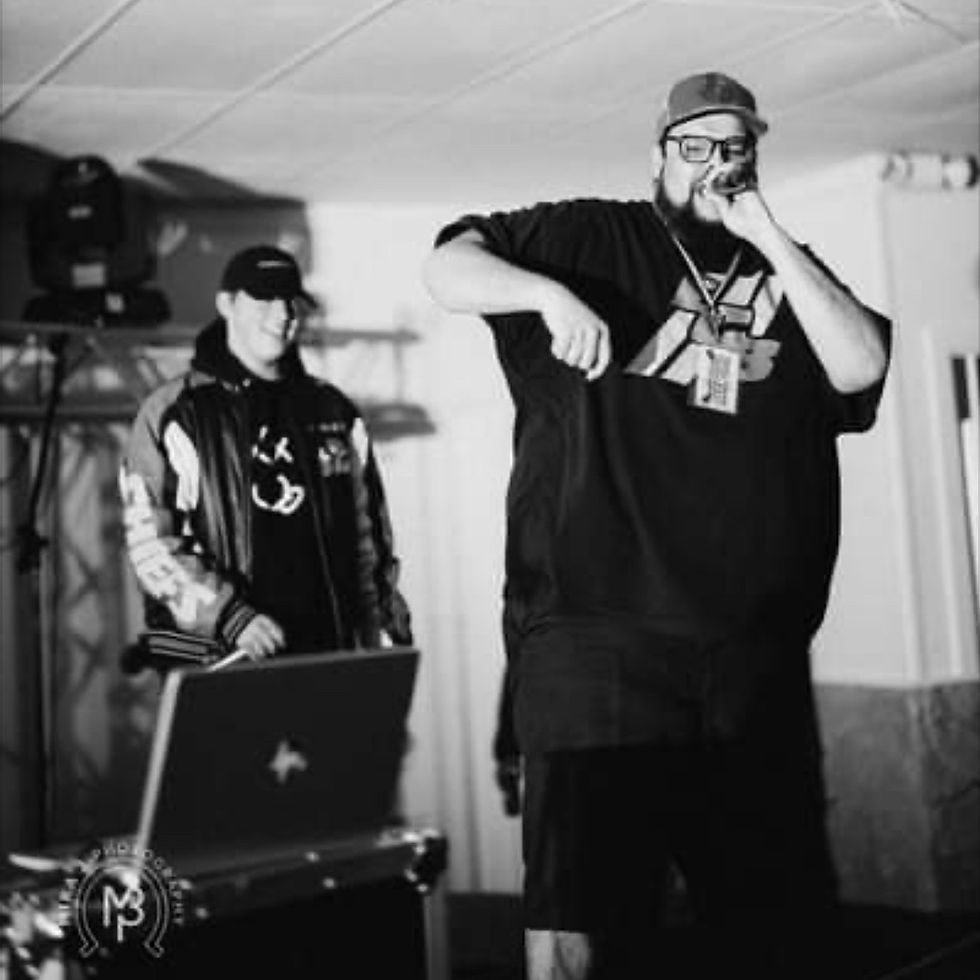
A: There’s an immediate and unmistakable honesty in an audience’s reactions that, if you’re paying attention, you can find while sharing poetry live that cannot be learned from written feedback. This is why I read at as many open mics as I’m able and have never turned down an invitation to be a featured reader. When performing, I look up from the page and into audience members’ eyes, intentionally engaging people at the back and in the front to increase connection and get a sense of how my poetry is landing. I can see it. I can hear it. And feel it. Applause is appreciated of course, and shows the depth of support and positivity in the room, but it’s the in-between reactions I primarily listen for: the groans, laughs, giggles, snaps, or any other verbalized response – they tell me what the audience is hearing and connecting to. The trick, then, for me, is to determine if that response is aligned with what I was trying to elicit – and if not, did the audience catch something unintended? Or, did they hear the thing I was saying but react in a way that revealed an image or twist that I undervalued and need to rethink? Or, did they catch something I hadn’t intended at all but was too good to not explore afterward and solidify through a potential edit? I learn all of this and more from performing my poetry live.
Q: How do you decide which poems to share live? Do you write poems specifically to be read live or is there another way you go about choosing poems for live readings?
A: There are only a small handful of poems that I don’t read live because they just aren’t built for that. Beyond that, I don’t have any hard-core rules about which poems to perform, though there are some general guidelines I’ve set-up. I keep track of every poem I read at every event I attend. I don’t want to repeatedly read a single poem to the same group, unless with intention. Keeping this log allows me to ensure that when I read a poem again to the same folk, I can also share my why for doing so. I might say “I simply need to read this one again” or “this poem feels timely and poignant, given the state of the world.” I believe they deserve to know that my reading a poem again is intentional and not allow them to assume that I just didn’t care enough to make sure I’m reading works that are new to them. Apart from all that, I might choose a poem because it’s very new and I need to hear how folks react to it, or newly edited with a twist that I added to, or pulled out of, it. There are also the poems that I lean on when reading to a group for the first time because I know those poems work as a strong introduction to who I am to who I am, and my senses of depth and of humor.
Q: Are you someone who naturally is drawn to creativity or is it something you have to implement into daily life?
A: While I’ve always been creative and have been writing since high school, I elected to follow a different passion for my career – education. Despite what non-teachers firmly (and incorrectly) believe, the teacher’s day does not end when the dismissal bell rings. Reading, lesson planning, grading. All of this happens after school hours. Tapping into my creativity was not an issue for me, but carving out the time within which I could do so was the challenge. Since I accepted my first high school English teacher assignment at Automotive High School in Brooklyn, NY in 1995, I also worked toward earning an MA in English, an MS E in education, and a doctoral degree in educational leadership. These things all took time. Additionally, I’ve tried my best to be present for and support my family during good times and emergencies. I would have moments when I focused on writing poetry, attending and reading at open mics, and finding journals that would publish my work. However, I was not skilled at ensuring the constancy of those creative practices. Before I knew it, years would pass while I was not creating. Repeat the cycle - I’d write, read, submit, then a decade would pass. This cycle repeated again until just under two years ago when I intentionally decided to take control and be intentional about prioritizing creativity. Since then, both myself and my art have grown for sure - and I make daily promises to myself and to my art that I will not stop this intentionality again.
Q: What kinds of moments or experiences tend to stay with you long enough to become poems?
A: I tend to hold onto pivotal moments – big or small. They can have happened to or with me, or moments that I observed. Such as: people leaving a tip at a café when the service they received was clearly lackluster; two people leave a store, pulling stolen chocolate out of their sleeve and giggling as they hurry off; what it can feel like to travel within New York City either by car or subway; needing to shift the focus of passion, etc.. I also hold onto moments of growth, reflection, or stagnation, usually focussing on the promises that I tend to see in everything, kept or missed, to another or to one’s self. I can read through all of my works and find the inherent promise and how that promise’s fulfillment, failure, or combination of the two is a thread that weaves throughout most, if not all, of my writing. In fact, the title of a poetry manuscript that was recently accepted for publication by The Poetry Lighthouse is titled Mumbled Promises.
Q: How do you think about connection when sharing your work? What do you hope an audience takes with them?
A: I want the crowd, or the single reader, to trust that they can open up and engage in a conversation with me and, if so inspired, continue that conversation in their own art. Whether I’m occupying space at the microphone or sharing my work through a journal with the knowledge that I won't meet the reader, I am absolutely interested in having the audience feel just how deeply I value their time and attention, and am honored by it. In person, I love nothing more than talking with the audience after the reading - hearing about how a poem or even a single line resonated. Similarly, when someone reads my poetry as published, if they react by thinking, reflecting, challenging and even potentially being inspired to create something of their own, the connection won't be felt in the moment, but it is one of the strongest connections I can imagine having with a reader.
Q: What role does vulnerability play in your writing practices?
A: All of my work comes from within. I’m constantly tapping into my perceptions, experiences, fears, and anxieties, and even in the darkest of poems, my hopes and aspirations. I often write narrative poetry, speaking in the third person and at the same time, can confidently say that I am in every poem, in one way or another. I share lessons learned, quiet truths I’ve picked up along the way, doubts and confidences, and unfiltered opinions, with no shortage of embarrassing circumstances being a common root. So, there is a core of vulnerability in my work, even and especially in the poems that reveal how I enjoy coupling deep meaning with dark satire. Using the third person, I assume, fools very few and therefore, I’m revealing myself to strangers as often as I’m able. While I’m not writing journal entries per se, I use my vulnerabilities to try and dive beneath the surface, of myself, partly as an outlet but certainly as a way to speak to the reader, as I can’t imagine a world where the vulnerabilities, desires, hopes, fears, and anxieties that I hold onto are mine alone. They are shared, and I try to tap into mine to write poetry that would speak directly to me, as a way of also speaking to you.
Q: Why are art and its history important?
A: Some of the oldest evidence of human expression is art, and in many cases, the architecture on which that art can be found. On cave walls. Incisions into a desert floor. Carvings into stone. So, we have art dating back as far as we have evidence of individual expression. Even when survival was a daily goal that was often beyond reach, people made space for art. This elevates art, to me, as something more than important. It’s a vital element of the story of people that must be explored if we’re ever going to come close to understanding ourselves. As to the various periods of artistic style and forms, I am fascinated by what those works say about individual artists, or even the societal norms that dictated what appeared within the works of art themselves. They tell us the stories that power demanded be told. And just as the visual artists might employ negative space, or the poet makes use of enjambment to create a cadence and essentially, sharing messages through empty (negative) spaces within stanzas, by exploring the art that was created at the mandate of power (whether governmental, religious-institution-driven, or by the wealthy class) we can also learn about the people not represented within the powerful class by examining the stories not being told within their endorsed/commissioned arts.
Blending humor, honesty, and reflection, Adam approaches poetry as a living conversation between writer and audience. His insights reveal not only a dedication to craft, but also a belief in poetry’s ability to create understanding, intimacy, and lasting human connection. Find him on IG at adam_breier_poetry.
Poems by Adam:
Broken
The pitcher
broken and glued, but
fractured.
Each crack
calling, for more
chipping
of the once solid confidence
that it could hold
everything
I had to pour.
Weakened
with poor repair.
Held together
by an unsettling web.
And I continue
to fill it
still.
(First published in Mad Persona Magazine. Issue 4. December 1, 2025)
Forethought
Consenting
to incessant cries
for change
they punctured their equilibrium.
Afterwards, numb
from the tug between
fight and flight
their hearts sweating
souls perseverating
waiting
without any control over
what was growing
beneath the scab
over the wound
that they told themselves they
still
wanted
while silently mourning
the thing they had
wounded.
(First Published in Friends of Friends Zine, Issue 2. February 23, 2026)
The Space Between Fingers
We had it pinched
in the places where
it was right
desperately tight
neglecting the places where
it was not
making it malleable, which it always was
of course
though we managed to make it
more so, pinching
as hard as we were
blinding ourselves
to how, had we just moved
the moveable
the spaces between our fingers
the pressures we applied
might not have made the beautiful, bulbous
the serene, slippery
a thing strangled
with no choice but to save itself
wriggling free
through those
very spaces we made.
(First published in Azarão Literary Journal. Issue V. February 15, 2026)


Comments